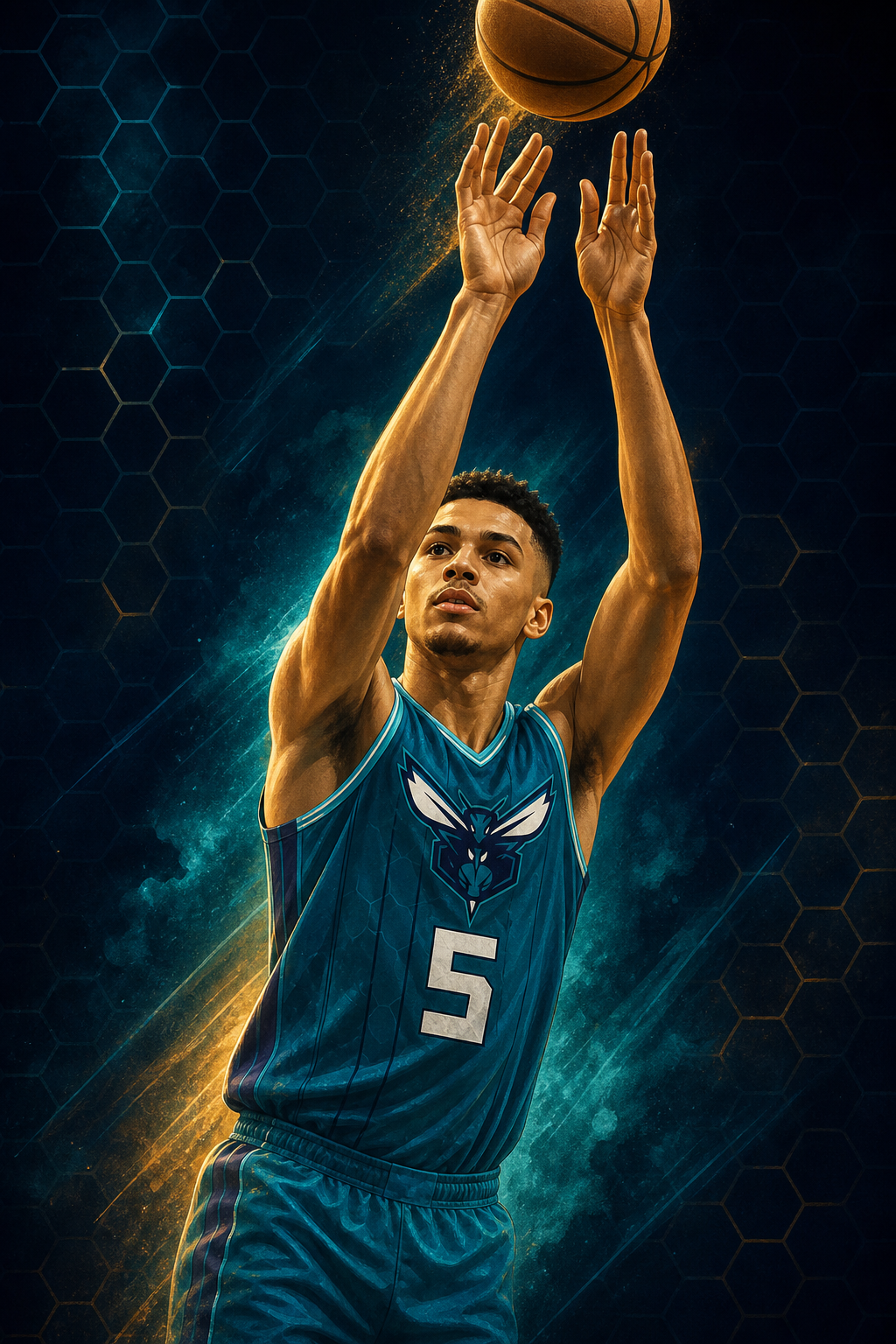
A lead-guard ceiling bet, a German-American passport, and the successor-plan question the front office spent all year dodging.
The Charlotte Hornets used the #18 pick in the 2026 NBA Draft on Christian Anderson Jr., a 6'0.75" lead guard out of Texas Tech. That's the short version. The longer version is why a 44-win team that finished nineteenth in the league in three-point rate spent a first-round pick on a backup point guard instead of a wing or a big — the same two positions they've spent three drafts chasing.
It's a fair question. Anderson is not a big, he's not a wing, and he played in the Big 12, not the ACC. He does not solve the "get bigger and more physical" mandate the front office made public in March. He is a 20-year-old point guard coming off a sophomore year in which he averaged 18.5 points, 7.4 assists and shot 41.5% from three on 108 makes. That's the pick.
Charlotte didn't draft a backup point guard. They drafted the backcourt running mate for whoever plays the 2 in 2027-28. Read it that way and the rest of the picture falls into place.
Anderson is a German national eligible for the German men's basketball program, with dual citizenship in the United States. The 2026 NBA Draft combine table lists him as "Germany / United States." He's spent summers with the German U16, U18 and U19 setups, won EuroBasket U18 gold, and took a silver at the U19 World Cup. The international résumé is not a footnote. It's the credential that separates him from the other high-volume sophomore guards in this class — Acuff, Flemings, Brown, Burries. He's a pro at twenty. He's a peer of Wembanyama's age group in the German pipeline.
No Ceilings called him the best pick-and-roll guard in the 2026 class. That's the most-searchable scouting claim in his file and it's worth holding onto: when the ball is in his hands at the top of the arc, he's deciding what to do with it before the defense decides to show. The decision-making maturity beyond his age — 2.4-to-1 assist-to-turnover as a sophomore — is the part scouts reach for when they want to defend the size. He has 96% of available minutes played. He never tires, never fouls. He plays like a fifth-year senior who got frozen at twenty.
The Hec Edmundson Pavilion is the place to see what he can do when the offense stalls. It's also worth noting: he was the highest-vertical point guard at the combine (40.5") and was a top-10 guard shooter on Day 1 of combine drills in Chicago. The pop is real, even if his in-game burst is good-not-elite — the combine number sets a ceiling most college 1s never test.
Charlotte owned two first-round picks this year — #14 (their own, lottery) and #18 (via Orlando). The front office did not pick Anderson at #14. If they had, the story would be different: a steal, possibly the highest-pick point guard in the class. They let Anderson sit through the #15-#17 selections, then took him at #18.
That timing says two things. First: the board was not unanimous inside the war room. Some voice wanted Morez Johnson, some wanted Yaxel Lendeborg, some wanted a wing. Second: the front office did not feel pressure to trade up. They didn't need to package #18 and a future first to lock Anderson in at #14 or #15. The market let them wait.
That's the most consequential detail in the pick. Charlotte was in position to trade up. They didn't. They took the board as it fell and grabbed the player they wanted at the slot they could afford. That's an inexpensive bet on ceiling, not an expensive one.
For the better part of June, three national reporters floated the same speculative frame on LaMelo Ball's future: would Charlotte consider moving him? The Hornets didn't engage with any of those stories. They didn't need to. Wednesday's pick answers the question anyway.
If Charlotte had been preparing to trade LaMelo this offseason, a luxury backup point guard on a rookie deal doesn't make sense. The thin depth chart behind LaMelo — Tre Mann, Josh Green, a transitioning White — has been the front office's biggest internal need for two years. Spending #18 on a 6'0" backup who's also the highest-ceiling lead guard in the class looks like a problem and an opportunity at the same time.
That's the Anderson thesis: he's LaMelo's eventual replacement if the front office ever needs one, and he's LaMelo's running mate if they don't. The NBA does not have many 20-year-olds who can credibly claim either role. Charlotte just bought themselves optionality at the position the franchise's future most depends on.
There's a quieter read here, too. If the trade rumors are wrong — if LaMelo is part of the long-term plan — then Anderson is a backup, and the bench suddenly has a second-unit creator who can play next to Mann or Green without forcing either of them off-ball. That's a real problem solved.
The size is real. At 6'0.75" barefoot with a 6'6.25" wingspan, he is short by NBA standards even accounting for the wingspan. He will be targeted in switches in the playoffs. The Alabama tape — 2-of-11 from the field, five turnovers, 25-point loss — is the one scouts who liked him least will point to. It's the honest tape.
But the floor isn't a bad player. It's a Tyus-Jones-with-scoring-2-or-3 who can run a second unit, hit a catch-and-shoot three, and never lose the offensive thread. The McCasland system at Texas Tech was excellent, and Anderson's production does have to be underwritten for scheme inflation — but scheme inflation doesn't change the 41.5% from three on 108 makes, the 7.4 assists, the 2.4-to-1 A/TO, the 96% of available minutes played. Those are player-credited, not system-credited.
The ceiling — per No Ceilings' pre-draft production chart — is Damian Lillard. That's aspirational. The honest read is Fred VanVleet with a smaller frame and better mid-range footwork, or a scoring version of Tyus Jones. Either of those is a top-six point guard in the league.
The most useful read of the pick is that it tells you what the front office thinks about the rotation. A team that needs a backup point guard takes a backup point guard in the first round. A team that thinks about a longer succession plan takes a backup point guard who might not be a backup by Year 3.
Good pick at the slot. Ceiling play with a defined floor. Charlotte didn't reach, didn't trade up, and didn't panic. Anderson at #18 is a high-end backup point guard with credible starter upside and a German-American passport that makes him the most internationally-ready young guard the Hornets have ever drafted. He does not address the size mandate for the 2025-26 roster. He addresses the bigger mandate: who runs this team in 2027-28 when LaMelo's contract discussions become a real part of the front office's calendar.
What changes the math is what happens between now and February. If Anderson holds his spot in the rotation and shoots the ball in the mid-to-high 30s from three on real attempts, the LaMelo-to-the-bench question answers itself. If he doesn't, he settles into a high-end backup role and the pick is a serviceable one. Either outcome is a fair read of where #18 should land in this class.
Related Swarm Outpost coverage: Christian Anderson and the Sophomore Surge · Hannes Steinbach: the size pick Charlotte needed · Bennett Stirtz and the Iowa Resurrection · Eastern Conference Blueprint.
Reply with a take — short or long. The Hive Talk is open to everyone.