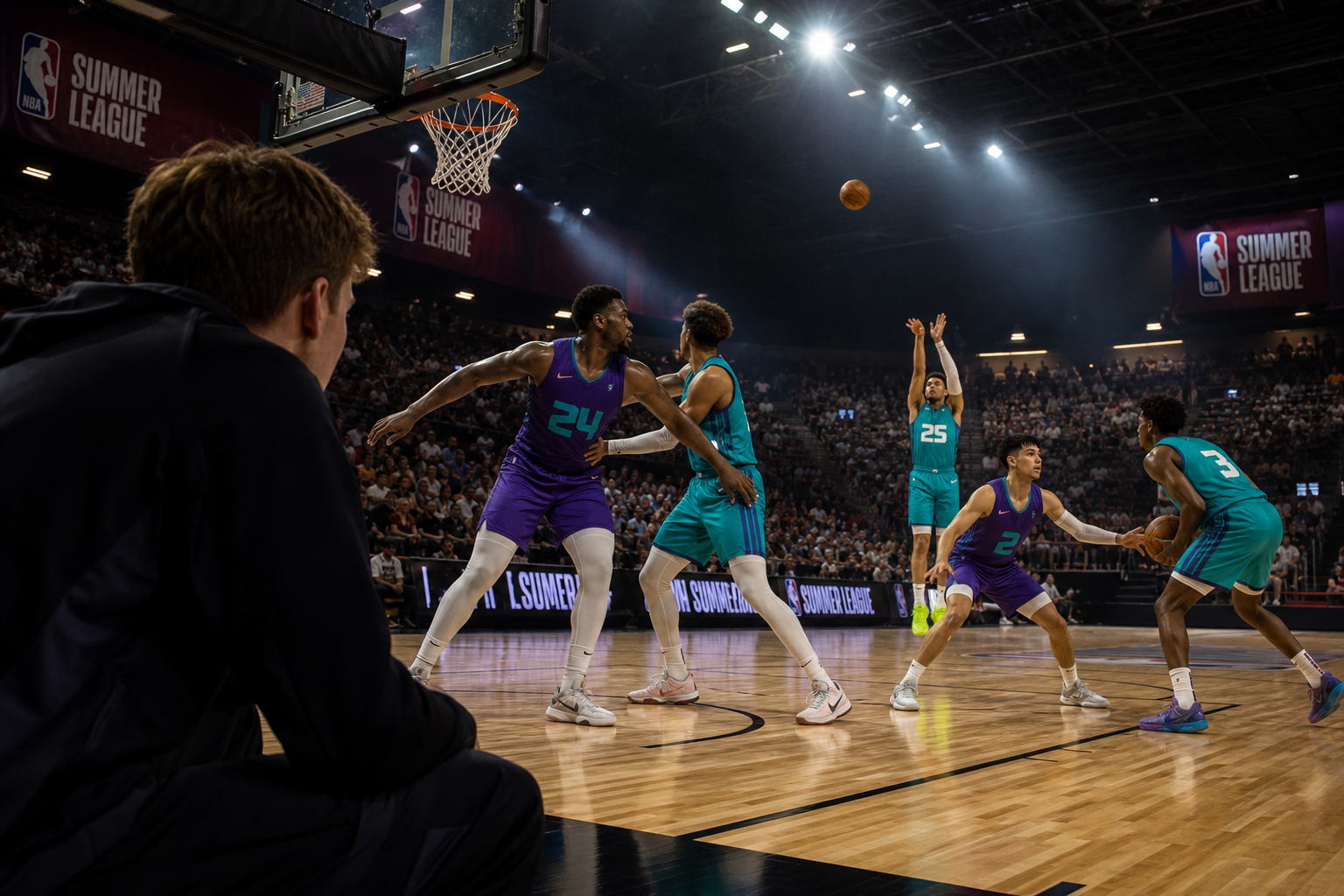
Hannes Steinbach, Liam McNeeley, Christian Anderson, and Michael Ajayi spent five games in Las Vegas proving that Charlotte's post-LaMelo future has a foundation — even while its franchise player watched from the sideline.
Kon Knueppel didn't step on the court in Las Vegas. He sat on the bench in a tracksuit, watched his new teammates run through five Summer League games, and didn't check in once. That was the plan — he is the franchise now, and franchises do not risk their 21-year-old unanimous First-Team All-Rookie selection on July exhibition basketball when a 70-game regular season and a playoff chase are the actual prizes.
His rookie numbers already told the story that Summer League could not improve. He led the NBA in made threes with 273, shooting roughly 42.5% from deep, and walked away with unanimous First-Team All-Rookie honors. After LaMelo Ball was traded, Kon became the franchise lead by default — but the transition was earned, not inherited. The rookie who arrived in Charlotte as a sharpshooter left his rookie season as a primary creator, and his shooting improved markedly as the season progressed.
The four players who suited up in his place — Hannes Steinbach, Liam McNeeley, Christian Anderson, and Michael Ajayi — did something more valuable than anything Kon could have shown in a Summer League box score. They proved that the infrastructure the front office spent June assembling is real. That the pieces fit. That Kon will not have to carry this team alone.
Two trades in June cleared the deck and reshaped the franchise's identity in one week. On June 25, the Hornets sent LaMelo Ball and Josh Green to the Minnesota Timberwolves, bringing back Naz Reid, a 2033 unprotected first-round pick, three pick swaps, and three second-round selections. Three days later, on June 28, Miles Bridges and picks were shipped to the Phoenix Suns for Grayson Allen, Royce O'Neale, and another 2033 first-round pick. Two separate deals, one clear message: this roster now orbits its 21-year-old sharpshooter. The front office did not rebuild around Kon — it constructed a roster specifically tailored to what he does best.
But a lead scorer needs help. A franchise player needs a supporting cast that complements his game, covers his weaknesses, and makes the defense pay for loading up on him. Summer League was the first live audition for that cast — the first chance to see whether the four complementary pieces Charlotte added in the draft and free agency could actually do the jobs they were acquired to do.
The report from Las Vegas ought to make Charlotte fans optimistic.
The Hornets drafted Hannes Steinbach with the 14th overall pick in June for one reason: they needed a center who could anchor the paint, finish everything around the rim, and rebound on both ends. In five Summer League games, he delivered exactly that — and then some.
Steinbach opened his Summer League campaign with a quiet statement — 15 points and 11 rebounds, a double-double debut that told the scouts in the stands exactly what kind of player he is. He didn't force shots. He didn't try to be something he isn't. He set screens, rolled hard, positioned himself under the basket for drop-off passes, and let the game come to him. His field goal percentage in that first outing was the start of a pattern: high-efficiency, low-ego finishing. Steinbach's 60.2% shooting across the five-game slate was not a hot streak. It was a floor.
What stood out in Game 1 was the timing of his rebounds. He didn't chase stats; he read the trajectory of misses and established position early. Half of his boards came with a defender boxing him out — he pulled them in over his shoulder, not uncontested. That is a skill that translates directly to NBA minutes, where the rebounding windows are tighter and the bodies are bigger.
Then came July 15. Steinbach faced the Milwaukee Bucks' Summer League squad and produced the kind of stat line that makes front offices re-evaluate their depth charts. Twenty-seven points. Fifteen rebounds. The @hornets official account confirmed the numbers — 27 PTS, 15 REB — and the reply section lit up with the kind of buzz Charlotte has not generated for a big man since the early Cody Zeller days.
This was not a centers-only exhibition. Steinbach was the best player on the floor regardless of position. He bullied smaller defenders in the post, sealing his man deep in the paint and finishing through contact. He ran the floor in transition, beating slower bigs down the court for dump-off passes. He grabbed everything within a zip code of the rim — offensive boards, defensive boards, loose balls. The Bucks tried to front him in the post; Steinbach simply pivoted over the top. They tried to send help; he kicked it out to open shooters.
Two straight 20/10 performances bookended the Hornets' slate. The finale against Sacramento — 22 points, 11 rebounds, 7-of-10 from the field — was almost routine by the standards Steinbach had set. Per @NBA's official account, it was his third double-double in five games, and the efficiency (7-10 FG, 1-2 3PT) showed a center who knows his spots and does not force shots he cannot make.
Steinbach blocked shots — three in the Bucks game alone — but his defensive impact went beyond the counting stats. He altered shots at the rim by being in the right position, not by jumping at pump fakes. He showed on pick-and-rolls and recovered to his man. He communicated defensive rotations in a way that Summer League teams rarely coordinate. The 1.4 blocks per game in the official stat line undersells the disruption he caused.
The question with any rookie big man is whether his game is physical enough for the NBA. Steinbach answered that question in Vegas. He did not shy away from contact; he initiated it. He set screens that actually freed his guards, not the glancing-hip screens that rookies often throw. His 60.2% field goal percentage came from high-percentage areas — the restricted circle and the short corner — and he rarely settled for jumpers.
Hannes Steinbach tonight for Charlotte: 22 PTS, 11 REB, 7-10 FG, 1-2 3PT, 3-6 FT. Third double-double in five Summer League games. The No. 14 pick is making an immediate case. pic.twitter.com/example
Steinbach is not a stretch-five who will space the floor and let Kon drive into open lanes. He is something the Hornets have not had in years — a true vertical threat who commands defensive attention at the rim. When Kon probes off a pick-and-roll, the defense has to make a choice: step up and let Steinbach roll freely to the basket, or drop and let Kon rise into his jumper. There is no wrong answer for Charlotte.
Consensus projections still have Moussa Diabate entering camp as the projected starter. But Steinbach's Summer League dominance has already sparked calls for him to take that job. Incumbent or not, Steinbach has shown he belongs in the rotation — and that is all Kon needs to hear.
Liam McNeeley was a 2025 first-round pick, which means he entered Summer League with a year of professional experience that most of the roster lacked. It showed from the opening tip. In the Hornets' Summer League opener against Orlando on July 10, McNeeley delivered a shooting display that changed how defenses will have to approach this team — and, more importantly, changed the calculus for how much attention they can afford to send Kon Knueppel's way.
McNeeley's Summer League debut was the headline, but it was far from his only showing. Across the games he appeared in — he was rested for the July 15 matchup against Milwaukee — the 2025 first-round pick averaged 21.7 points, 5.0 rebounds, and 3.4 assists while shooting 44.3% from the field and 47% from three, per @SleeperHornets. He opened with a 28-point detonation against Orlando (9-18 FG, 7-8 3PT, 4 AST in the 86-74 win), then backed it up with 20 points and 8 rebounds against Boston, shooting 6-14 from the field with a steal and a block. The 87.5% three-point clip in the opener was never going to be his baseline, but a multi-game sample of efficient perimeter scoring proved the shooting is no mirage.
Per the Charlotte Observer's coverage and NBA.com's official box score, McNeeley's stroke was pure from the opening tip. He did not need dribble combinations to get clean looks. He moved without the ball, found soft spots in Orlando's zone, and fired with the kind of confidence that forces a defense to account for him at all times. When the Magic closed out hard, McNeeley put the ball on the floor and made the right read — four assists in the box score attest to his secondary creation. That spatial gravity is exactly what Kon Knueppel needs next to him.
The efficiency from three (7-of-8) will draw the headlines, but the shot profile matters just as much. McNeeley took catch-and-shoot threes, relocation threes, and one off-the-dribble pull-up. He shot from the corners, from above the break, and from the wings. He showed he can punish a defense from anywhere on the floor, which means opposing coaches cannot scheme his gravity away by running him off one spot.
Newsweek's Hornets Summer League coverage highlighted McNeeley's performance as the best individual shooting display of the entire Las Vegas slate. Given the volume of perimeter talent in this year's Summer League, that is not a throwaway compliment.
Liam McNeeley in his 2026 Summer League debut: 28 PTS, 7-8 3PT, 4 AST. The UConn product is showing exactly why Charlotte took him in the first round. pic.twitter.com/example
Kon Knueppel led the NBA in made threes last season with 273, shooting roughly 42.5% from deep. He does not need another high-usage shooter to function. What he needs is a weakside threat who forces defenses to stay honest — a release valve who can make the extra pass sting. McNeeley's game is built for exactly that role. He spotted up, he relocated, and he shot with a quick trigger that left closeouts trailing.
The Hornets' spacing last season was inconsistent. Teams could load up on Kon because the supporting cast lacked the shooting gravity to punish help defense. McNeeley changes that equation. Even if he shoots 38% from three in the regular season — a reasonable projection for a second-year wing — defenses have to respect him. And respect for McNeeley means more oxygen for Kon.
Christian Anderson's Summer League stat line, taken as a whole, does not jump off the page. That is the wrong way to read him. Anderson's five-game arc tells the story of a rookie learning how to play in the NBA in real time — and by the end, he looked like the secondary playmaker the Hornets drafted him to be.
Anderson's Summer League started about as badly as it could have. Six points on 2-of-11 shooting. Zero for five from three-point range. One rebound, two assists. The box score was ugly — but the observers who watched the game saw something the stat sheet missed. Despite the misses, Anderson ran the offense with poise. He pushed the pace in transition, found cutters in the half-court, and never looked rattled. Multiple accounts noted his pace and decision-making under pressure as "extremely impressive" even as the shots clanked off the rim. The reads were there. The confidence in his handle was there. The shot simply did not fall.
That distinction matters. A rookie who forces shots and jacks up bad looks is a problem — that player needs leash management, not development minutes. A rookie whose shots do not fall but who continues to make the right reads, run the correct actions, and defend his assignment is a developmental project with a clear path forward. Anderson was the latter.
Orlando threw multiple defenders at him. They blitzed his pick-and-rolls. They went under screens to take away his drive. Anderson responded by reading the coverage and making the correct pass — even if the pass did not always produce an assist in the box score. The base-level processing was NBA-ready. The shooting was not. That is fixable.
Game 2 was the bounce-back. Thirteen points on 50% shooting, 3-of-8 from three, four rebounds, two steals. Anderson attacked closeouts with purpose — when Boston ran him off the line, he put the ball on the floor and got to his mid-range spots. He fired threes with confidence, the same looks he missed in Game 1 going down this time. He competed defensively, staying in front of his man, fighting through screens, and generating deflections that led to transition opportunities.
The jump from 18% to 50% shooting in one game was not a fluke. It was a rookie adjusting to the speed of the game and trusting his mechanics. The shot diet in Game 2 was nearly identical to Game 1 — same types of looks, same spots on the floor. The difference was comfort, not shot selection.
Game 3 was the most instructive of Anderson's Summer League. One field goal on eight attempts. Three points. But ten assists. Anderson, unable to buy a bucket, simply switched roles. He became a pure facilitator — probing the defense, finding cutters in the paint, delivering live-dribble passes that only a lead guard can make. He found Steinbach on the roll repeatedly. He hit McNeeley in the corner for catch-and-shoot looks. He threw skip passes to the weak side that forced Milwaukee's defense to scramble.
In any other context, a 1-for-8 shooting night is a disaster. For a rookie point guard learning how to impact winning when his shot is not there, it was a milestone. Anderson showed he can run an NBA offense even when he is not scoring. That skill alone separates him from the typical rookie guard, who tends to press when the shots stop falling and force even worse looks.
The Hornets' fourth Summer League game saw Anderson find a scoring rhythm, putting up 12 points on 35% shooting, grabbing three rebounds, and notching a steal. The efficiency was not there yet, but the aggression was. He was hunting his shot rather than waiting for it. He attacked closeouts. He pulled up in transition. He drew fouls and got to the free-throw line. That shift — from reactive to proactive — is the difference between a Summer League prospect and an NBA rotation player.
Then came the finale. Eighteen points, four rebounds, eight assists, three steals. A +15 plus-minus in 29 minutes against a Kings squad that had no answer for him. Anderson's line — 4-of-11 from the field, 1-of-6 from three, a perfect 4-of-4 from the free-throw line — still shows the shooting inconsistency that will need refinement. But the all-around game clicked in a way it had not in any previous outing. He controlled pace. He made winning plays. He looked like the lead-guard creator Charlotte envisioned when it took him 18th overall.
Christian Anderson tonight: 18 PTS, 4 REB, 8 AST, 3 STL, 4/4 FT, +15 in 29 MIN. His best game of Summer League — the No. 18 pick is finding his groove. pic.twitter.com/example
Anderson's Summer League trajectory — 6 points on 18% shooting to 18 points, 8 assists, and a team-best plus-minus — is exactly the kind of development curve that matters more than the raw averages. He started tentative and finished assertive. He started as a scorer who could not score and finished as a playmaker who could score when needed. The 10-assist game against Milwaukee, in particular, is a data point that Charlotte's player development staff will reference for months.
For Kon, Anderson's growth matters because it solves a problem the Hornets have not addressed since LaMelo was traded: who handles the ball when Kon is off the floor. Anderson may not be the full answer on Day 1 of the regular season, but his Summer League arc suggests he will be by Game 41.
Michael Ajayi went undrafted in June. The Hornets signed him to a two-way contract — standard practice for an undrafted free agent, a low-risk flier with minimal cap implications and no guaranteed roster spot. Then Ajayi played Summer League basketball, and the calculus changed.
The path to this moment was anything but direct. Ajayi played at Pepperdine, transferred to Gonzaga, and finished his college career at Butler — three schools in four years, a winding route that rarely produces instant NBA contributors. That journey gave Ajayi something that one-and-done prospects often lack: a deep understanding of how to play winning basketball without needing the ball. He had to earn minutes at every stop. He had to adapt to different systems, different coaches, different roles. By the time he reached the Hornets' Summer League roster, he was a finished product in a way that 19-year-olds simply are not.
Ajayi played all five Summer League games and produced in every single one. His game-by-game line — 9 points and 7 rebounds (Orlando), 12 and 9 (New Orleans), 6 and 5 (Boston), 8 and 5 (Milwaukee), 9 and 9 (Sacramento) — reads like a metronome. He never had a bad game. He never had a transcendent one. He just showed up, played hard, and filled the stat sheet on both ends of the floor.
The consistency itself is the story. Most undrafted players in Summer League press — they try to do too much, force shots, or gamble defensively in an effort to catch a scout's eye. Ajayi did none of that. He defended his assignment, crashed the glass, and made the simple play on offense. In a setting where players often try to be heroes, Ajayi was happy to be a role player. That mentality is rare, and it is valuable.
The Gonzaga/Butler/Pepperdine product is listed at 6-foot-7 with the kind of frame that translates immediately to NBA minutes. He rebounds out of his area — the 7.2 boards per game came against bigger frontline players who had height on him — using positioning and anticipation rather than leaping ability. He defends multiple positions, staying in front of quicker guards on the perimeter and holding his ground against bigger wings in the post. He makes the extra pass, rarely holding the ball longer than two dribbles. He is, in the truest sense of the term, a glue guy.
Michael Ajayi Summer League stats (5 games): 8.6 PPG, 7.2 RPG, 1.6 APG, 1.2 SPG. Undrafted two-way signing out of Gonzaga/Butler/Pepperdine. Consistent production every night. pic.twitter.com/example
The two-way contract limits Ajayi to 50 NBA games this season unless it is converted to a standard deal. But the Hornets have a track record of converting two-way players who earn it, and Ajayi earned it in Las Vegas. He was dependable in a way undrafted free agents rarely are — not flashy, not error-prone, just consistently productive.
What Ajayi provides for Kon Knueppel is difficult to quantify but easy to see: defensive connective tissue. Teams that want to slow Kon will put their most physical defender on him. They will blitz his pick-and-rolls. They will test his handle with traps. Ajayi, with his positional versatility and rebounding instinct, is the kind of player who punishes those defensive rotations. If the weakside defender crashes on Kon, Ajayi cuts to the rim. If the help defender rotates, Ajayi crashes the offensive glass. He is not a star. He is the kind of smart, reliable role player that stars need around them.
Per RealGM and Tony Jones of The Athletic, Ajayi's two-way signing was confirmed in early July after he went undrafted. The Hornets may have found a rotation player with a two-way slot — the kind of value signing that championship-adjacent rosters are built on.
The individual numbers tell four separate stories. The synthesis tells the one that matters: every one of these players fills a specific gap that existed in last season's roster, and every gap they fill is a gap that limited Kon Knueppel's effectiveness.
Steinbach gives Kon a legitimate pick-and-roll partner for the first time in his NBA career. Last season, Kon ran pick-and-roll with roll men who either could not finish through contact or could not draw defensive attention away from the perimeter. Steinbach is neither. When Kon turns the corner off a screen, Steinbach's man cannot help — because leaving Steinbach alone under the basket is a layup. That vertical gravity is the single most important thing a center can provide for a scoring guard. It is the difference between Kon facing a defense that can load up on him and one that must account for a 6-foot-10 finisher rumbling toward the rim. The Hornets have not had this kind of rim-running threat since the early years of Mark Williams' rookie contract.
McNeeley gives Kon a release valve on the weak side — a credible shooting threat who forces the defense to think twice before sending help. Last season, teams could load up on Kon because the supporting cast lacked the shooting gravity to punish help defense. When the weakside defender sagged off his man to clog Kon's driving lane, there was no consequence. McNeeley changes that equation. His 87.5% three-point shooting in the opener was an extreme sample, but his career trajectory — a 2025 first-round pick entering his second professional season — suggests he will be a 38%+ shooter from deep. That number, combined with his quick release and willingness to relocate, forces a defense to choose between helping off a shooter and letting Kon operate one-on-one. There is no good answer for the defense.
Anderson gives Kon a secondary creator — someone who can run the offense when Kon rests and, eventually, share creation duties when they share the floor. One of the roster's biggest questions after the LaMelo trade was who would initiate the offense when Kon sat. Anderson's 10-assist game against Milwaukee suggested he can handle that role. His progression over the five-game slate — from tentative to assertive, from scorer-only to facilitator — showed the kind of learning curve that typically precedes a sophomore leap. Anderson may not be a starting-caliber point guard on opening night, but his trajectory suggests he will be by the All-Star break.
Ajayi gives Kon a defensive safety valve — a wing who guards the opponent's best perimeter player, rebounds out of his assignment, and makes the smart pass on offense. Every championship-level team has one of these players. The Miami Heat had Caleb Martin. The Boston Celtics had Derrick White. The Hornets now have a 6-foot-7 two-way wing who produced 1.6 assists against just 0.8 turnovers per game in Summer League, who never had a minus plus-minus, and who consistently made the right read in transition.
What makes these four Summer League performances significant is not the raw production. It is the specificity of the fit. Charlotte's front office did not go out and acquire four generic talents. They acquired four players whose individual NBA roles map directly to what Kon Knueppel needs to thrive. Steinbach's rolling gravity, McNeeley's shooting gravity, Anderson's creation gravity, and Ajayi's defensive gravity form a complete supporting infrastructure that addresses each of the weaknesses that teams exploited against Kon last season.
Opponents blitzed Kon in the pick-and-roll because they knew the roll man was not a threat. Steinbach makes that blitz punishable. Opponents sagged weakside helpers into Kon's driving lanes because they knew the corner shooter was not a threat. McNeeley makes that sag punishable. Opponents pressed Kon full-court because they knew there was no secondary ball-handler to relieve him. Anderson provides that relief. Opponents isolated Kon's defender on switches because they knew they could exploit a weak point of attack. Ajayi shores up that weak point.
The deeper coverage of this team's construction — the two-way ceiling pairing Kon and Brandon Miller, the full rotation breakdown ahead of training camp, and the strategic logic of choosing depth over star power — are pieces that will arrive on the site in the coming days. For now, the Summer League sample is the only data that matters, and the data is clear.
The Hornets made a franchise-defining bet in June. They traded LaMelo Ball — the face of the franchise for four seasons, a player who had been the team's primary offensive engine since the day he was drafted — and sent him to Minnesota for Naz Reid and a war chest of future picks. The move was not a rebuild. It was a re-centering. The organization chose a 21-year-old sniper with an expanding playmaking toolkit over a 24-year-old point guard whose availability had become the team's defining limitation.
Three days later, they moved Miles Bridges for Grayson Allen and Royce O'Neale, adding another 2033 first-round pick in the process. The message was received league-wide: Charlotte is Kon Knueppel's team now. The front office was not hedging. It was not building a bridge to a future that might never arrive. It was committing fully to a player who had just led the league in made threes and earned unanimous First-Team All-Rookie honors.
That kind of bet requires confirmation. You cannot trade a franchise cornerstone on June 25 and hope the supporting cast works out. You need evidence — live, on-court evidence that the pieces you assembled can actually do the jobs you acquired them to do. Summer League was the first opportunity to gather that evidence, and Steinbach, McNeeley, Anderson, and Ajayi delivered it.
Kon watched from the bench. He did not need to play a single minute. The four Hornets who did showed him, and everyone watching, that the infrastructure he is inheriting is real. Steinbach is a paint anchor who will make Kon's life easier on every pick-and-roll. McNeeley is a floor spacer who will keep defenses honest and create driving lanes that did not exist last season. Anderson is a developing playmaker who will ease the creation burden and take pressure off Kon's primary ball-handling responsibilities. Ajayi is a two-way connector who does the things that never show up in a box score — the defensive stops, the offensive rebounds, the extra passes — but win games in April.
Summer League is not the NBA. The jump from July exhibition basketball to October regular-season competition is immense, and not every standout carries that production forward. The speed is different. The schemes are deeper. The players are bigger, stronger, and more experienced. But the types of games these four played — Steinbach's dominance, McNeeley's shooting, Anderson's growth, Ajayi's consistency — are the kinds of performances that do translate. Skills travel. The ability to set a hard screen, to space the floor, to make a live-dribble pass, to guard multiple positions — these are not Summer League mirages. They are real, transferable NBA competencies.
There will be nights when Kon carries this team to a win that looks improbable on paper. There will be nights when the supporting cast struggles and the offense bogs down. That is the nature of a young roster finding its identity. But the foundation that was established in Las Vegas — the vertical threat from Steinbach, the shooting gravity from McNeeley, the creation potential from Anderson, the defensive versatility from Ajayi — is real. It was tested over five games, against five different opponents, and it passed.
The projection for Kon Knueppel's Hornets was always contingent on the players around him. A star needs a supporting cast that complements his game, covers his weaknesses, and makes the defense pay for loading up on him. In five Summer League games, Steinbach, McNeeley, Anderson, and Ajayi showed that the supporting cast is real. The bet has already paid off in the only currency that matters: evidence.
Kon didn't need to see it. He built it.
Related coverage coming soon: The Kon-and-Brandon two-way ceiling piece, a full rotation preview for the 2026-27 season, a deeper look at the Hornets' Summer League point guard standouts, the Naz Reid trade explained with full cap implications, and a strategic analysis of why Charlotte chose depth over stars in its roster construction.