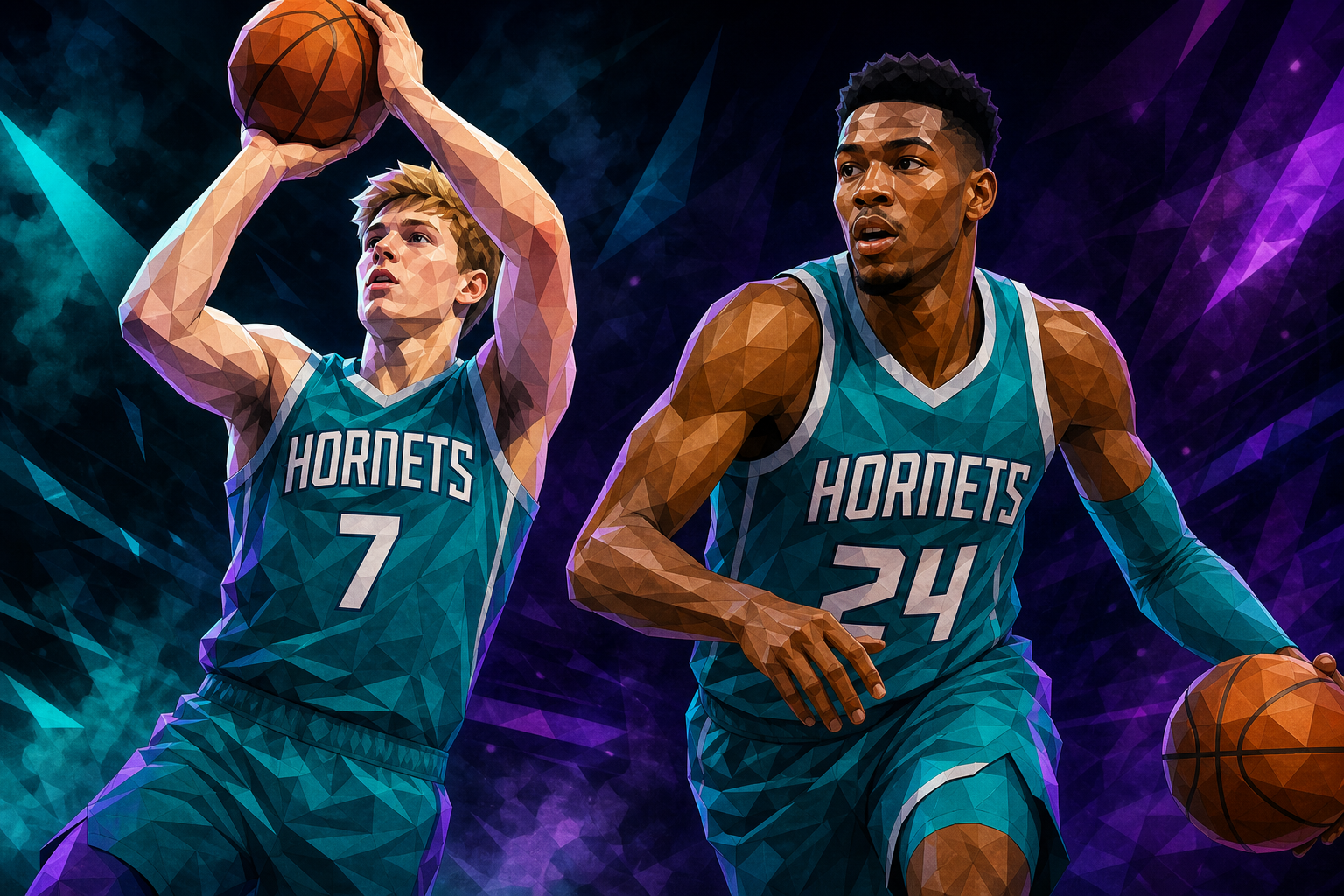
Kon led the NBA in threes as a rookie. Miller dropped 20/5/3 in a full season. With LaMelo and Bridges reportedly on the move, Charlotte's new core is already on the roster.
March 13, 2025. ACC Tournament quarterfinals. Duke vs. Georgia Tech. Seven minutes in, Cooper Flagg — the generational freshman who would become the No. 1 pick — landed awkwardly, grabbed his ankle, and limped to the locker room.
And then Kon Knueppel took over.
The 6'7" wing had been, until that moment, the second option — the smart, steady, 38%-from-three complementary piece who let the superstar do the heavy lifting. When the superstar went down, Kon put up 28 points and 8 assists in 35 minutes. Duke won 78-70. Two days later, he dropped 17 against North Carolina in the semifinal. Two days after that, 18 points and 8 rebounds in the championship game. Duke won the ACC Tournament title. Kon was named ACC Tournament MVP.
Three games. One trophy. One scouting report dismantled.
The scouting criticism of Kon Knueppel coming out of Duke was always the same refrain: "Is he athletic enough to create separation in the NBA?" The question followed him through the pre-draft process and into the green room. When Charlotte took him 4th overall in June 2025, the national analysts split — some saw a safe floor-spacing wing, others wondered if the Hornets had reached.
Kon answered the way shooters always answer: by making shots. He led the entire NBA in three-pointers as a rookie (273 makes) — ahead of Curry, ahead of Edwards, ahead of everyone. He finished 2nd in Rookie of the Year voting behind Cooper Flagg. The "too slow" criticism evaporated somewhere around the 150th make. Two hundred seventy-three threes is not a "safe pick" number. It's a foundational-piece number.
Brandon Miller's 2025-26 season tells two stories depending on how you read the stat sheet.
The surface read: 20.2 points, 4.9 rebounds, 3.3 assists per game over 65 games — 43.5% from the field, 38.3% from three. A very good third-year leap from a former No. 2 overall pick. The Hornets reached the play-in tournament, beat Miami, and pushed Orlando before losing in the first play-in game.
The deeper read: Miller played 65 games. After a wrist injury limited him to just 27 games in 2024-25 — a season where his per-game numbers (21.0/4.9/3.6) actually surpassed his rookie year in rate — the availability question was the only real knock on his trajectory. He answered it. He stayed on the floor, played through contact, and logged the kind of season that makes front offices believe they have a franchise wing.
The Hornets' post-All-Star surge in 2025-26 coincided with Miller's best stretch of basketball — something the front office noticed when deciding the direction of the offseason.
With LaMelo Ball and Miles Bridges both traded in the summer 2026 blockbuster deals — Ball to Minnesota for Naz Reid, Bridges to Phoenix for Grayson Allen and Royce O'Neale — Miller becomes the clear No. 1 option by default. Not by projection. By roster construction. The two players who averaged more shot attempts than him in 2025-26 (Ball at 18.4 FGA, Bridges at 16.1) are gone.
The projected usage bump is real — though the exact percentage is speculative. What is measurable: Miller averaged 20.2 points on 15.3 field goal attempts per game in 2025-26. Ball and Bridges combined for 34.5 attempts per game. Even if Allen, O'Neale, and Knueppel absorb half of those, the remaining half puts Miller at 22-23 attempts per game — a trajectory that, at his efficiency, produces 26-27 points per game.
Here's the math that defines Charlotte's 2026-27 season. LaMelo Ball and Miles Bridges combined for roughly 47 points per game in 2025-26 — Ball's All-Star production (23-24 PPG, 8+ APG) plus Bridges' two-way scoring (22-23 PPG). That is not a hole in the rotation. That is a crater.
Three players have to fill it. Here's how the math works:
Coby White averaged 15.6 points in 21 games with Charlotte after the trade — and that was as a secondary option. As the starting point guard with primary initiation duties, his attempts will rise. In Chicago, when given starter's minutes, White averaged 19.1 PPG. A reasonable projection for White in the Hornets' system: 17-19 PPG on 16-17 FGA, with the playmaking load pushing his assists to 5-6 per game.
Brandon Miller has the runway to go from 20.2 PPG to 24-26 PPG simply by absorbing the shots Ball and Bridges left behind. He averaged 15.3 FGA in 2025-26 — the 11th-highest usage on the team. With Ball (18.4 FGA) and Bridges (16.1 FGA) gone, and no single player replacing those shot totals, Miller's attempts should climb to 19-21 per game. At his efficiency (43.5% FG, 38.3% 3PT), that math produces 24-26 PPG.
Kon Knueppel is the wild card. He led the NBA in three-pointers as a rookie (273 makes) — a number that puts him in the top 5% of floor spacers in the league entering year two. But he averaged only 11.3 FGA as a rookie. If that number climbs to 14-15 FGA — and his catch-and-shoot efficiency holds — he's a 16-18 PPG scorer who stretches the defense so far that Miller and White have driving lanes they've never had before.
Add it up: White (17-19) + Miller (24-26) + Knueppel (16-18) = 57-63 PPG from the three core perimeter players. That's more than Ball and Bridges combined, and it's distributed across three players instead of two — meaning no single injury derails the entire offense the way Ball's absence did in previous seasons. The depth isn't just a nice-to-have. It's the whole point.
Ball and Bridges were 47 PPG of star-centric creation. White, Miller, and Knueppel are 57-63 PPG of distributed, system-based offense. The math is the philosophy.
The most interesting question of the Hornets' 2026-27 season is not whether Kon Knueppel is a real NBA player — he's already proven that — or whether Brandon Miller is a star — the arc is clear. The interesting question is: what do they look like on the floor together?
Two wings, drafted two years apart, who share the same foundational skill — shooting — but deploy it differently.
Miller is a self-creator. He generates offense off the dribble, in isolation, out of pick-and-roll. He averaged 3.3 assists not because he's a natural point wing but because the defense had to respect his pull-up and he learned to read the help.
Knueppel is a movement shooter who can also operate as a secondary creator. His 28-point/8-assist game against Georgia Tech is not an outlier — it's the profile the Hornets drafted. A 6'7" wing who can run off screens, spot up, and make the extra pass. In a backcourt with Coby White (who signed a 3-year, $74M deal on July 6) handling primary creation, Knueppel slots into the exact role that maximizes his strengths: catch-and-shoot threat who can attack closeouts.
The complementary fit is clean: Miller isolates; Knueppel spaces. Knueppel draws the second-best perimeter defender; Miller attacks the weaker matchup. Naz Reid's 39.5% three-point shooting from the 5 position creates the kind of driving lanes both wings feast on.
There are three things that can slow this down, and they deserve to be named.
1. Brandon Miller's shoulder surgery. On May 6, 2026, Miller underwent left shoulder surgery. The Hornets have described it as routine cleanup, but any surgery on a 23-year-old's shooting shoulder in May of an offseason when the roster is being rebuilt around him warrants attention. The recovery timeline suggests he'll be ready for training camp, but summer development time — the exact window when core players build chemistry — is affected.
2. The "too much creation on one player" trap. With Ball and Bridges gone, Miller becomes the only player on the roster who can consistently create his own shot against a set defense. Coby White (15.6 PPG with Charlotte) can do it in bursts. Kon Knueppel can do it situationally. Naz Reid can do it from the post. But in crunch time, when the defense loads up, Miller will see packages he hasn't seen before. How he handles them determines whether Charlotte's offense is average or bottom-five.
3. The defensive fit. Miller has improved defensively every year, but he's not a stopper. Knueppel is a high-IQ team defender who lacks elite point-of-attack foot speed. The backcourt of White (6'5") and Knueppel (6'7") is big, which helps. But the wing combination of Miller and Knueppel will need schematic protection — something Charles Lee's staff has been building toward but hasn't proven at a high level yet.
Charlotte's bet on Kon Knueppel and Brandon Miller as the core of the next competitive Hornets team is not a projection. Miller has already produced at a near-All-Star level in a full season. Knueppel has already led the league in three-pointers as a rookie. Both are 23 or younger. Both are on rookie-scale contracts that give the front office cap flexibility through 2028.
The question isn't whether they're good enough. It's whether the supporting cast — Coby White, Naz Reid, Grayson Allen, Royce O'Neale, Grant Williams, Hannes Steinbach, Christian Anderson Jr. — is good enough to make them better. That's a better question than the Hornets have been able to ask in a decade.
For the first time since the Kemba Walker era, Charlotte has two wings who can shoot, defend their position, and create offense. The ceiling depends on how high the team around them can lift.
Related Swarm Outpost coverage: Why the Hornets Traded LaMelo for Naz Reid · Why the Hornets Took Christian Anderson Jr. at #18 · Hannes Steinbach: the size pick Charlotte needed.
Miller has the self-creation and the draft pedigree. Knueppel has the rookie record and the ACC Tournament moment. Where do you lean?